
We do not request reimbursement of costs
(such as repayment for obtaining medical records)
from veterans nor from people who suffer from multiple sclerosis.
- Call today for a free evaluation
- 1-888-774-7243
SSDI Eligibility for Veterans: What You Need to Know
Veterans sacrifice so much in service to this country — and for many, those sacrifices come with lasting physical and mental health consequences. If a serious medical condition is now preventing you from holding steady employment, Social Security Disability Insurance (SSDI) may provide critical monthly income while you focus on your health and recovery. Yet many veterans don’t realize that VA disability compensation and SSDI are entirely separate programs — and that qualifying for one does not automatically mean you’ll qualify for the other. This guide walks through exactly how SSDI works for veterans, which conditions qualify, and how to build the strongest possible claim.
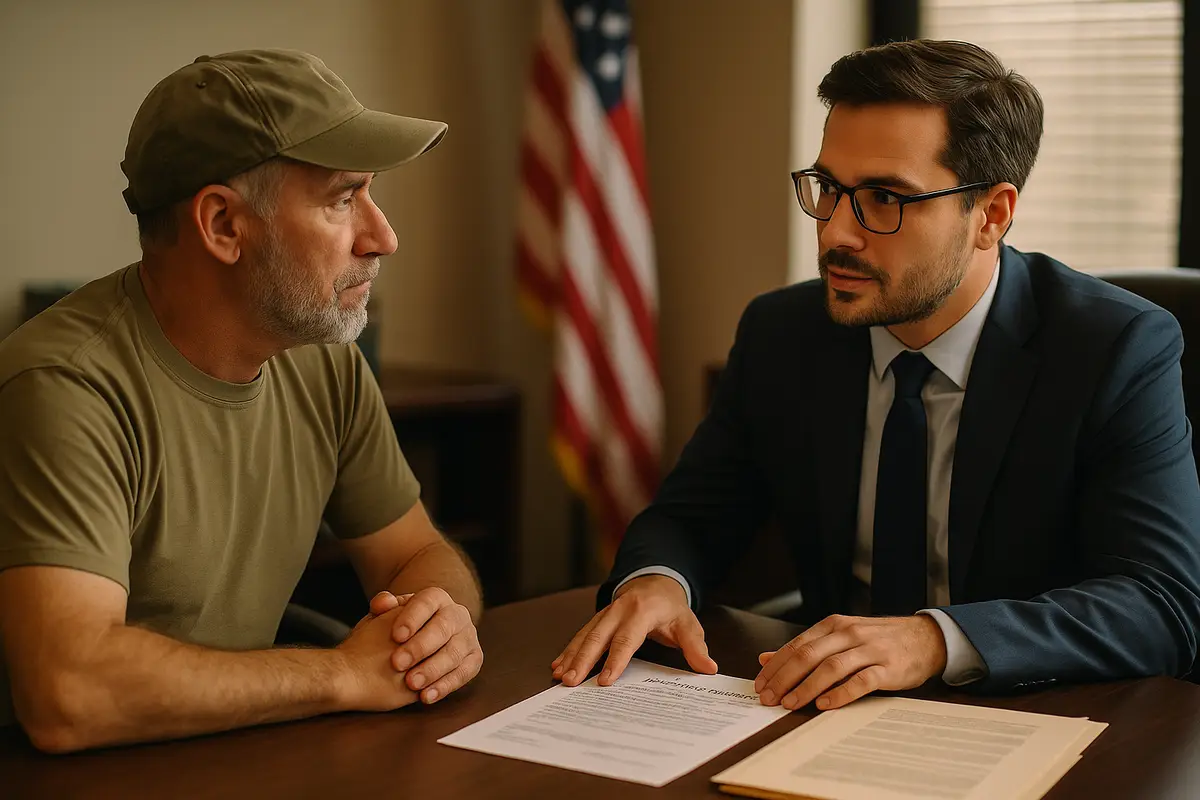
SSDI vs. VA Disability Benefits: Understanding the Difference
Before diving into eligibility, it’s important to understand what separates these two programs. VA disability compensation is awarded by the Department of Veterans Affairs based on how much your military service contributed to a current health condition. SSDI is administered by the Social Security Administration (SSA) and pays benefits when any medical condition — service-connected or not — prevents you from working for at least 12 continuous months.
A 100% VA disability rating does not automatically guarantee SSDI approval. And a lower VA rating doesn’t disqualify you either. The SSA applies its own independent medical and functional standards regardless of what the VA has decided.
Basic SSDI Eligibility Requirements for Veterans
To qualify for SSDI, every applicant — veteran or civilian — must satisfy two core requirements:
- Work credits: You must have worked in Social Security-covered jobs and accumulated enough credits. Most applicants need 40 credits (roughly 10 years of work), with at least 20 earned in the 10 years before disability onset. Military service counts toward Social Security credits.
- Medical eligibility: Your impairment must prevent you from engaging in Substantial Gainful Activity (SGA) and must be expected to last at least 12 months or result in death.
How the SSA Evaluates Disability Claims
The SSA uses a five-step sequential evaluation process to decide every SSDI claim:
- Step 1 — Are you working? Earning above the SGA income threshold generally means you are not considered disabled.
- Step 2 — Is your condition severe? Your impairment must significantly limit your ability to perform basic work activities.
- Step 3 — Does your condition meet a listed impairment? The SSA’s Blue Book contains medical criteria for hundreds of conditions. Meeting a listing results in automatic approval.
- Step 4 — Can you perform your past work? If your condition allows you to return to your previous job, your claim will likely be denied.
- Step 5 — Can you do any other work? The SSA considers your age, education, and complete work history to determine whether any jobs in the national economy remain within your capacity.
Medical Conditions That Commonly Qualify Veterans for SSDI
Veterans are eligible for SSDI based on the same conditions as any other applicant. That said, certain health problems arise with far greater frequency among those who have served:
- Post-Traumatic Stress Disorder (PTSD) — one of the most common service-connected impairments and a recognized basis for SSDI under the SSA’s mental disorder listings.
- Traumatic Brain Injury (TBI) — causing cognitive difficulties, mood disturbances, and physical limitations that can prevent sustained employment.
- Chronic back and neck injuries — resulting from the physical demands of active-duty service.
- Hearing loss and tinnitus — evaluated under the SSA’s special senses listings.
- Cardiovascular conditions — including heart disease caused or worsened by service.
- Respiratory diseases — particularly those linked to toxic exposure, such as burn pit smoke or chemical agents.
- Fibromyalgia — a chronic widespread pain condition that frequently co-occurs with PTSD and other service-related conditions. The SSA recognizes fibromyalgia as a disabling condition when properly documented with consistent medical evidence.
- Neurocardiogenic syncope — a type of autonomic nervous system disorder that causes recurrent fainting episodes, making regular and reliable attendance at any job unsafe or impossible.
- Dementia and cognitive decline — particularly relevant for veterans experiencing early-onset memory loss or cognitive deterioration tied to TBI, toxic exposure, or neurological damage from service.
- Pseudotumor cerebri (idiopathic intracranial hypertension) — a neurological condition causing severe chronic headaches, vision disturbances, and other debilitating symptoms that significantly impair the ability to function in any work setting.
Veterans dealing with multiple co-occurring impairments — physical and psychological — often present stronger SSDI cases, because the SSA evaluates the combined functional impact of all conditions rather than each impairment in isolation.
Does a VA Rating Help Your SSDI Claim?
Yes — and you should always include your VA rating decision with your SSDI application. While the SSA makes its own independent determination, a VA disability rating is considered meaningful supporting evidence that the adjudicator must weigh. A 100% permanent and total (P&T) VA rating carries particularly strong weight and may qualify you for expedited processing under the SSA’s Wounded Warriors initiative.
That said, many veterans with partial ratings of 30%, 50%, or 70% also qualify for SSDI. What matters to the SSA is whether your conditions prevent you from sustaining any work on a regular and continuing basis — not the percentage the VA assigned. The SSA analysis centers on your residual functional capacity and ability to maintain employment.
The Wounded Warriors Expedited Processing Program
Service members and veterans who became disabled while on active military duty on or after October 1, 2001 may qualify for the SSA’s Wounded Warriors initiative. This program fast-tracks SSDI applications without changing the underlying eligibility standards. To take advantage of it, your application should clearly state that your disability arose during active duty service.
How to Build a Strong SSDI Application as a Veteran
The evidence you submit is one of the biggest factors in whether your claim succeeds. Here is what veterans should prioritize:
Compile Comprehensive Medical Records
Your VA healthcare records are a critical asset. Request a complete copy — including treatment notes, imaging results, mental health evaluations, and specialist reports. Also gather records from any private physicians, hospitals, or community providers outside the VA system. Incomplete or inconsistent records are among the top reasons SSDI claims are denied, so make sure your documentation tells a thorough, consistent story across all providers.
Document How Your Conditions Limit Daily Functioning
The SSA is less focused on your diagnosis and more focused on what you cannot do because of it. Be specific about how your impairments affect your ability to stand, walk, lift, concentrate, follow multi-step instructions, manage stress, or maintain appropriate relationships with coworkers and supervisors. Written statements from family members or caregivers can further support your account.
Maintain Consistent Medical Treatment
Ongoing and consistent medical treatment directly strengthens your claim’s credibility. The SSA views unexplained gaps in treatment as evidence that your condition may not be as severe as you claim. Staying engaged with your healthcare — even when progress is slow — demonstrates that your impairments are genuine and persistent.
What to Do If Your SSDI Claim Is Denied
Most initial SSDI applications are denied — but a denial is not the end. The SSDI appeals process includes reconsideration, a hearing before an Administrative Law Judge (ALJ), review by the Appeals Council, and ultimately federal court review. Veterans should never treat a first denial as a final answer.
The ALJ hearing stage is where the majority of successful claimants ultimately win their cases. You have the opportunity to present updated medical evidence and live testimony about how your conditions affect your daily life and ability to work. Review what happens after an SSDI application is denied for a full breakdown of each appeal level and what to expect.
Why Veterans Should Work With a Disability Attorney
Navigating both the VA and SSA systems simultaneously is demanding and complex. A disability attorney who understands federal benefit claims can help you gather the right evidence, present your functional limitations persuasively, and avoid the procedural errors that result in unnecessary denials. Our detailed guide on how legal representation improves outcomes in SSDI claims explains what an attorney actually does at each stage and how to evaluate your options.
At Chermol & Fishman, we represent veterans pursuing SSDI on a contingency basis — no upfront costs, and we never seek reimbursement from veterans for costs such as obtaining medical records. You pay nothing unless we win your case.
Serving Veterans Across the United States
Chermol & Fishman represents disabled veterans throughout the country. We have offices and serve clients in:
- Florida — Miami, Tampa, Orlando, Jacksonville, Fort Lauderdale, and surrounding communities.
- Texas — Houston, Dallas, San Antonio, Irving, Plano, and more.
- New Jersey — Camden, Newark, Cherry Hill, Trenton, and across the state.
- Pennsylvania — Philadelphia, Pittsburgh, Bucks County, Montgomery County, and throughout the Commonwealth.
Ready to Start Your SSDI Claim?
If you are a veteran whose medical condition is keeping you out of the workforce, you may be entitled to SSDI benefits — and you don’t have to figure it out alone. Contact Chermol & Fishman today at 1-888-774-7243 for a free, no-obligation evaluation. We handle veterans’ SSDI claims on a contingency basis and never seek reimbursement of costs from veterans. Your service deserves recognition — let us help you secure the benefits you’ve earned.
Frequently Asked Questions: SSDI for Veterans
Can a veteran receive both VA disability compensation and SSDI at the same time?
Yes. VA disability compensation and SSDI are independent programs administered by separate federal agencies. Receiving one does not reduce or eliminate the other. Many veterans collect both monthly payments simultaneously.
Does a 100% VA disability rating automatically qualify me for SSDI?
No. A 100% VA rating is strong supporting evidence and may qualify you for expedited SSA processing, but the SSA applies its own independent definition of disability. You must still demonstrate that your conditions prevent you from performing any work in the national economy under SSA standards.
How many work credits do veterans need for SSDI?
Generally, 40 work credits — roughly 10 years of employment — are required, with at least 20 earned in the 10 years before disability onset. Military service counts toward Social Security credits. If your disability began at a younger age, fewer credits may be sufficient.
What is the Wounded Warriors program?
The SSA's Wounded Warriors initiative expedites SSDI processing for veterans and service members who became disabled while on active duty on or after October 1, 2001. It does not alter the eligibility criteria but moves the application through the system significantly faster.
Can PTSD qualify a veteran for SSDI?
PTSD is a recognized basis for SSDI under the SSA's mental disorder listings. If your symptoms — such as intrusive memories, hypervigilance, severe anxiety, emotional dysregulation, or inability to maintain concentration and social functioning — are severe enough to prevent any sustained work, you may qualify for benefits.
What if I have multiple conditions such as fibromyalgia and PTSD?
The SSA evaluates the combined impact of all your impairments. Veterans dealing with overlapping diagnoses — such as fibromyalgia alongside PTSD, TBI, or neurocardiogenic syncope — often present stronger claims because the combination of limitations eliminates more work options than any single condition would.
What if my SSDI application was denied?
You have the right to appeal at multiple levels. Most successful claims are won at the ALJ hearing stage. Review your full options after an SSDI denial to understand the complete appeals timeline and what steps to take immediately after receiving a denial notice.